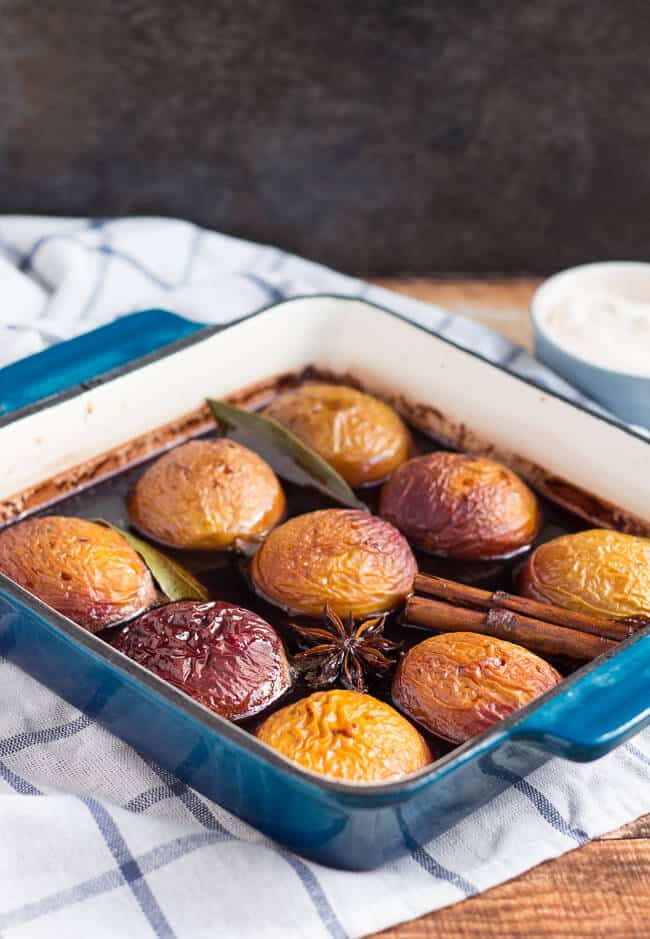
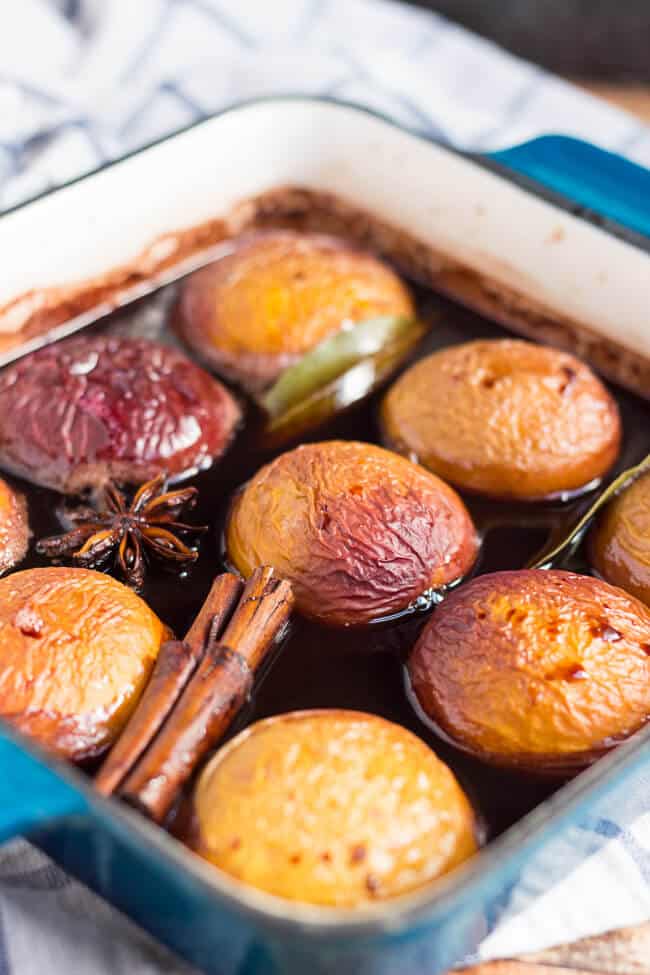
Roasted (or baked depending on where you live in the world) nectarines in red wine are the perfect make-ahead dessert for summer entertaining. The red wine melds with the juices of the fruit and the spices, producing a delicious syrup that is best licked straight off the spoon. Serve with thick cream or ice cream for the perfect end to dinner.
Total Time Investment: 45 Minutes
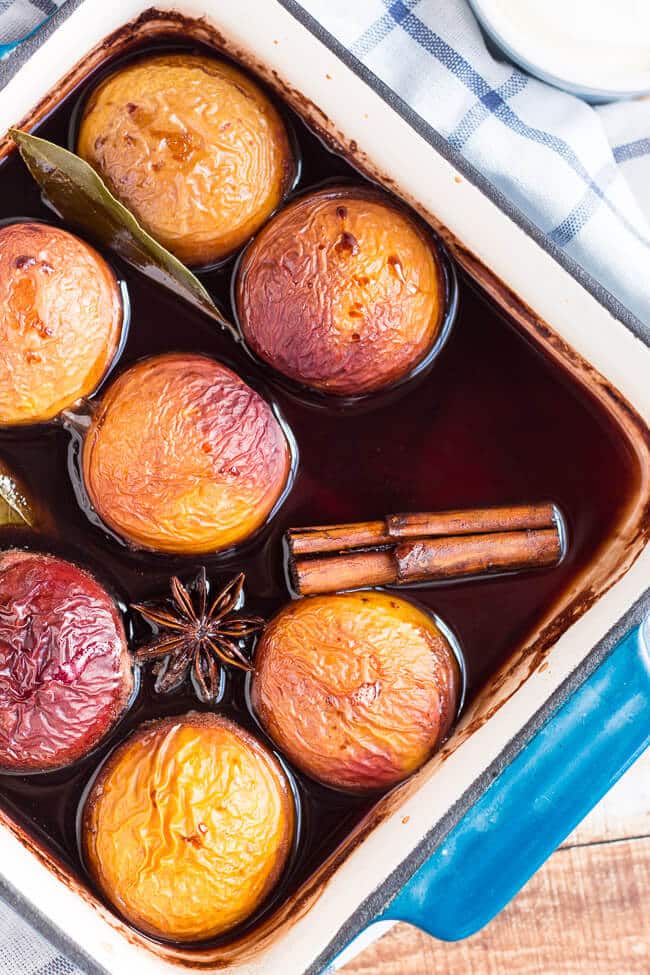
Berries aside, I’m not a huge fan of fresh fruit. I put this down to the fact that fruit was difficult to source in the country when I was a child, unless you had your own tree, and a lot of the fruit I remember eating as I grew up was from a tin.
These days, I still prefer to eat fruit that has been cooked in some manner. My favourite way to treat almost any fruit is to add a little sugar, some spices and a slosh of alcohol, and throw the whole lot in the oven: a technique that works particularly well for strawberries, berries and all stone fruit.
Why These Baked Nectarines Work
I was first introduced to the idea of roasting nectarines in red wine many years ago when we lived in England. Our good friend Sue, a truly amazing cook, served this glorious dish to Mr Grumpy and I as the perfect end to a superb meal.
A tray of these roasted nectarines have appeared in my kitchen every summer since that first meal, almost twenty five years ago now. I use either peaches or nectarines depending on the quality of the fruit available; some years the nectarines are better, in others the peaches shine.
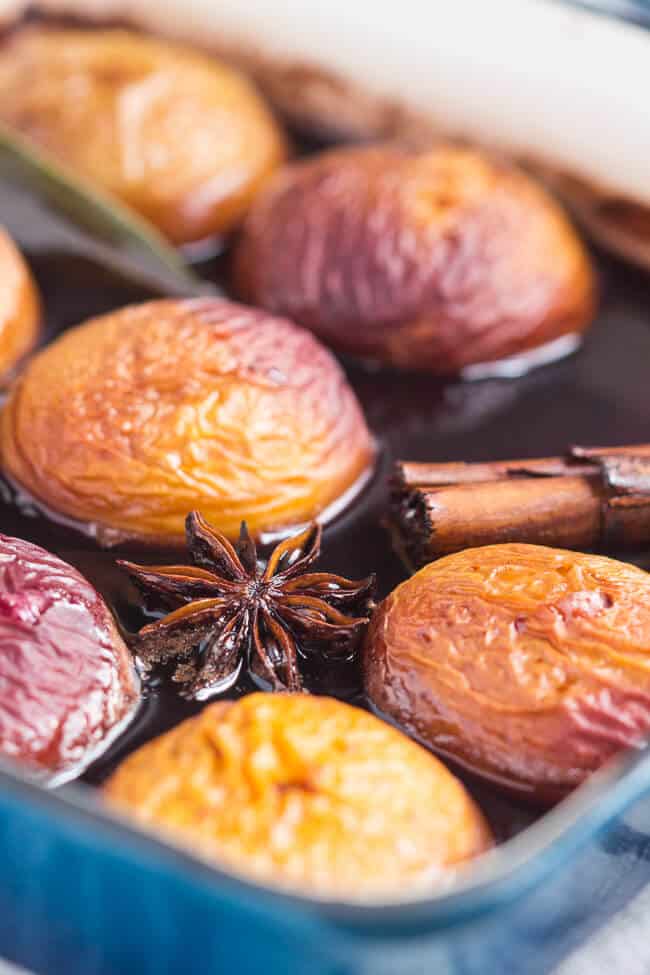
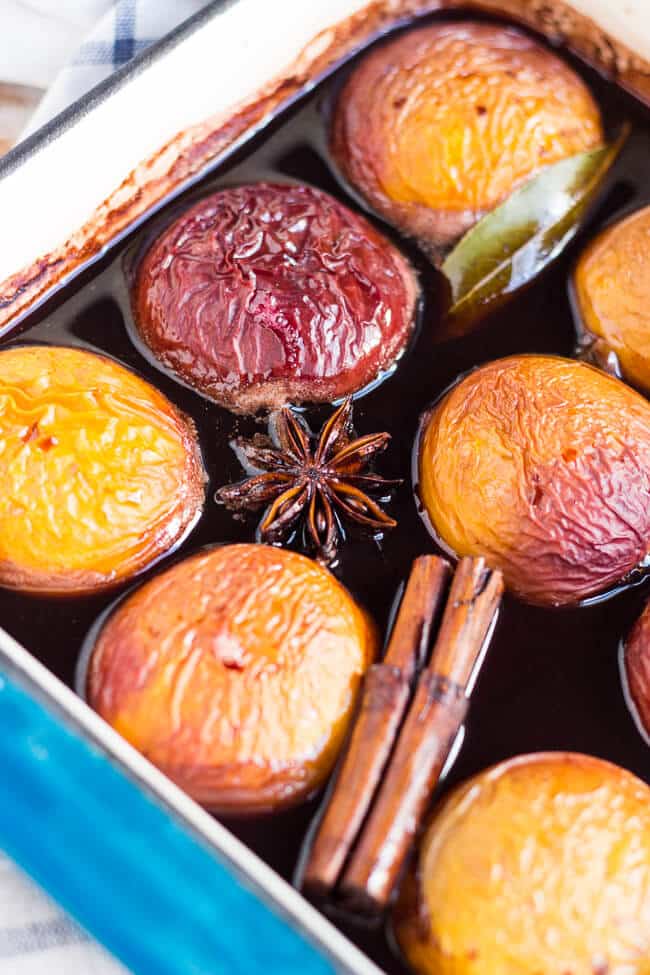
These baked nectarines in red wine are the sort of dessert you can throw together with minimal fuss and still feel a bit impressive. The fruit turns tender and jammy around the edges but should still hold its shape, while the red wine cooks down into a lightly spiced, syrupy sauce that’s perfect over ice cream, yoghurt or a simple slice of cake.
Roasted nectarines are a great make ahead option (see my tips below) so are great for dessert when you’ve served salad for dinner, or are an easy make-ahead option for summer entertaining because the dish tastes even better once it’s had time to sit and soak up the flavours. The nectarines taste delicious both warm or at room temperature, and leftovers have even been known to make an appearance at breakfast in my house.
This recipe is also ripe for experimentation, and I have played with it a quite bit over the years by switching up the spices and the poaching liquid. My tinkering always produces edible results, yet I invariably return to this version. What can I say, it truly is the best. And I am aware that whilst bay leaves are an unusual inclusion in dessert, the leaves have a green, spicy aroma that pairs beautifully with the fresh fruit.
*We are a participant in the Amazon Services LLC Associates Program, an affiliate advertising program designed to provide a means for us to earn fees by linking to Amazon.com and affiliated sites.
Ingredient Substitutions for Roasted Nectarines
Feel free to tinker with this recipe to your heart’s content, and experiment according to what is in your pantry. Nectarines and peaches both work beautifully here, so I tend to use whichever looks best on the day.
- Nectarines: You can use peaches as a straight swap. Choose fruit that’s ripe but still firm so it roasts without collapsing.
- Bay leaves: Fresh bay leaves work best if you can get them (don’t forget they freeze well), but dried bay leaves will still give you that aromatic, savoury edge in the syrup. If you can’t get bay leaves at all, or don’t like the idea of using them, add a few sprigs of fresh thyme instead. Lemon thyme if you can get it would work really well here.
- Sugar: Swap the dark muscovado for either dark brown sugar or rapadura sugar. You can also use maple syrup instead of sugar; just start with a smaller amount and then add more later if you want it sweeter. Taste the syrup at the end of the cooking time and adjust it if necessary. If it’s too sharp, add a little extra sugar or maple syrup. If it’s too sweet, a squeeze of lemon juice can help balance it out.
- Spices: Cloves and allspice berries work well, and a few black peppercorns in the syrup can add a subtle warmth. If you don’t have cinnamon quills, try ½ teaspoon ground cinnamon stirred into the wine. You can also add a split vanilla pod to the baking dish for extra flavour.
- Liquid: Red wine makes the richest syrup, but you can use white wine for a lighter, fruitier result. If you’d rather avoid wine, apple juice works too (the syrup will taste more like a spiced fruit glaze than a wine reduction). When choosing a red wine, use something you would happily drink. It doesn’t need to be expensive. It just needs to taste good. I find a medium-bodied red tends to work best here. Very tannic or well-bodied reds tend to taste a bit sharper once reduced.
I think that red wine produces the best syrup in this dish, and the finished syrup tastes rich and mellow. The alcohol in the wine cooks off during baking, so I have no qualms about serving this dish to children. The Princess loves them. However if you are truly concerned, use a good non-alcoholic red wine.
How to Make These Roasted Nectarines Ahead of Time
This dish is delicious served either warm or at room temperature, so it is the perfect dish for making ahead.
I do this in one of the following two ways:
- Place the fruit, sugar, wine and spices in the dish, then set aside. If you wish to serve the nectarines warm, slide the tray into the oven just before you serve the main meal.
- Bake the dish before your guests arrive, and allow it to sit at room temperature until required. The dish will sit happily for a few hours out of the fridge.
The roasted nectarines can also be cooked the day before required. Refrigerate overnight, and allow to come back to room temperature before serving.
Serving and Storage of Baked Nectarines
Serving Suggestions
These roasted nectarines are delicious served either warm or cold. And don’t forget to spoon plenty of syrup over the fruit as you serve it.
Some of my favourite serving ideas:
- I think they are best served warm with ice cream or thickened cream, Greek yoghurt, mascarpone or crème fraîche.
- These nectarines are also delicious spooned over pavlova, pancakes/waffles, or granola.
- If you want to add a little crunch to the final dish, scatter over a handful of chopped toasted almonds or pistachios just before serving.
- They are great with yoghurt for breakfast.
Storage Tips for Leftovers
I often have leftovers when I make this dish, mostly as I plan it that way. We love these so are happy to eat them for a few days. My tips for the best tasting leftovers:
- Cool the nectarines completely, then refrigerate them in the syrup in an airtight container.
- Leftovers will keep well for about 3 to 4 days, and they often improve after a day or so as the flavours mingle.
- Reheat large quantities gently in a moderate oven. Individual serves can be zapped in the microwave.
- Technically it is possible to freeze leftovers of this dish. I’ve not tried it myself, but just be aware that the fruit is likely to soften once defrosted. I would definitely serve a defrosted dish warm, and be aware you may end up with stewed fruit in red wine instead.
Common Problems and Fixes
If anything goes a bit sideways when baking (or roasting) nectarines in red wine, here are a few quick fixes to get you back on track:
- Your nectarines turn to mush: Make sure to use firm-ripe fruit and start checking the fruit earlier in the cooking time. Softer (riper) nectarines will need less time in the oven.
- Your nectarines are hard at the end of the cooking time: Your fruit was not quite ripe. Cover the dish with foil and keep checking every 5 minutes. They will soften eventually.
- The syrup is too thin: Lift out the fruit, then simmer the liquid on the stove for about 5–10 minutes to reduce to the syrup. Put the fruit back in the dish and pour the syrup over.
- The syrup tastes too sharp or tannic: Stir a little extra sugar or maple syrup into the liquid and add a tiny pinch of salt. Next time you make the dish, choose a softer, medium-bodied red.
- The syrup is too sweet: Add a squeeze of lemon juice to balance it out.
- Reheating the dish has dried out the syrup: Add a little water to the syrup and stir thoroughly. Cover with foil and let it reheat for a further 5 minutes to redistribute the flavour.

Frequently Asked Questions
1. Do I need to peel the nectarines?
No you do not need to peel the nectarines. The skins soften as the nectarines bake and are perfectly edible. I would only peel the nectarines if you prefer the appearance of them in the final dish.
2. I would like to peel the nectarines. How do I do this?
- Bring a saucepan of water to a rolling boil and have a bowl of iced water ready nearby.
- Score a small shallow X on the bottom of each nectarine.
- Drop each nectarine into the boiling water for about 20 to 40 seconds (start at 20; very ripe fruit will need less time). Time this step.
- Lift the nectarine out of the boiling water and drop it straight into the iced water to stop the cooking process.
- Once cool, use your fingers or a small knife to lift the skin from the X and peel it off.
Note: Nectarine skins can be more stubborn than peach skins. If blanching doesn’t loosen the skin easily, your fruit is probably slightly underripe. You can either extend your blanching time by 10 seconds or use a small knife to shave the skin off the nectarine, making sure to follow the curve of the fruit.
3. What size baking dish should I use?
As this recipe is quite flexible, and the size of your fruit will vary each time, it is difficult to recommend a specific dish size. Choose a dish that will enable you to lay the fruit in a snug, single layer. Not too deep (the fruit should be level with the top of the dish or slightly peek out from the top) or the liquid will take too long to reduce.
4. Do I place the nectarines cut side up or cut side down?
You can place the fruit either way. Cut side up, edges of the fruit can caramelise slightly in the oven. Cut side down the fruit quietly poaches in the liquid. If placing your fruit cut side up, I would baste once or twice during cooking to encourage the edges to caramelise.
5. How do I know when the nectarines are done?
The nectarines are ready when the fruit is tender when pierced but are still holding their shape. The exact cook time will depend on the ripeness of your fruit; riper fruit will cook quicker.
6. I overcooked the nectarines. Have I ruined it?
No, it’s still fine. I can’t tell you how many times I’ve made this recipe and forgotten they are quietly cooking in the oven. The fruit will look a little more shrunken but still taste delicious.
7. Can I serve these cold?
Absolutely! They are delicious cold. The spice flavours become more apparent and the syrup thickens slightly. They are delicious.
8. What is the best way to reheat the dish?
I find the best way to reheat a whole dish of roasted nectarines, still in the syrup, is to cover the dish with foil and place it in a moderate oven for about 15 – 20 minutes. They don’t need to be piping hot. Just warm them enough to take the chill off them.
Individual nectarines can be reheated in the microwave.
9. Can I double the recipe for a crowd?
Yes, easily. Simply use a larger baking dish so you can fit all the fruit in it. If you do put everything in one dish, you can either reduce the liquid slightly, or simply allow a little extra time for the syrup to reduce in the oven (because there’s more volume). Keep an eye on it near the end and take it out when the nectarines are tender and the syrup looks glossy.
Note: a wide, shallow dish will help the syrup reduce faster than if you use a deep dish.
Oven Roasted Nectarines in Red Wine
Ingredients
- 6 firm, but ripe, nectarines (or peaches) halved, and the stone removed.
- 500 ml (2 cups) Red wine
- 2 Tablespoons dark muscovado sugar
- 2 bay leaves preferably fresh
- 2 cinnamon quills
- 1 star anise
Instructions
- Pre-heat the oven to 200C (180C fan forced).
- Place the nectarines cut side down in a large baking dish.
- Gently pour the red wine into the dish. The wine should reach at least halfway up the side of the nectarine. If you want more syrup, add a little more red wine.
- Sprinkle the sugar over the nectarines, allowing it to fall into the wine.
- Tuck the bay leaves and spices amongst the fruit.
- Bake for approximately 40 minutes, or until the fruit has softened and a glossy syrup has formed in the base of your baking tray. You can baste the fruit during the cooking process. I usually forget this step, and it doesn’t seem to impact greatly on the end result.
- Serve the nectarines warm, or at room temperature, with ice cream and lashings of thick cream.
Notes
Nutrition
* This post was originally published in March 2013. It was updated in March 2017. I have now substantially updated and revised the information here to make it more useful.


Oh my goodness I’m in love!! I’ve made red wine poached pears for years but I adore this! I’ve found the white peaches to be really good this summer and just froze a few the other day to enjoy them during the colder months 🙂 Thanks for joining the hop!
It’s funny how fruit varies from season to season isn’t it. Peaches have been very average this year over here and nectarines not that much better but a little heat (and wine) hides some of those flaws : ) I am stocked up on apricots though because they were great this season. Thanks for having me : )
These look gorgeous. Can’t wait until summer (Australia) to try it.
Thank you. They are a regular in our house in summer. Thanks for visiting.
Hi Tania
I have 8kg of nectarines and would like to us the above recipe with red wine probably a shiraz.
once cooked how long would the nectarines last if I bottle them?
Virginia
Hi Virginia. I have used Shiraz before with great success. However, I am slightly concerned that if you bottle the nectarines after roasting them, the nectarines will be very soft and may fall apart. I have never tried to preserve them in that manner. I have bottled fruit previously by pouring red wine straight into the preserving jar with the fresh fruit. I can tell you this doesn’t work well so I wouldn’t recommend it.
If you do decide to try bottling the roasted fruit, I think they would last at least 12 months. Is it the low sugar content that concerns you? I preserve most of my fruit with little or no sugar, and have great success keeping them for long periods (up to 12 months).
I love roasting summer stone fruit – especially the hard, unripe fruit that is so often in the stores these days. I haven’t tried doing it with red wine though. It’s on my list now!
I am firmly of the opinion that all fruit is improved by a slosh of alcohol Amanda 😀